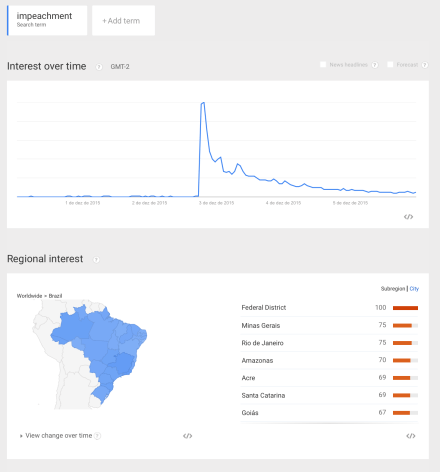
Impeachment no Google Trends


Captura de Tela 2015-12-06 às 10.10.34

Previsões para o Impeachment


Agora que o processo foi aberto, acho que muitos vão querer brincar com diferentes cenários. Por enquanto conheço apenas duas ferramentas que possam satisfazer um pouco sua curiosidade:

1. O Polling Data do Neale, que tem uma seção para o impeachment (vá em Modelos/Big Data e depois em impeachment); e

Captura de Tela 2015-12-02 às 22.01.36

(se o site não funcionar agora, tente novamente mais tarde, o Polling Data está passando por problemas técnicos)

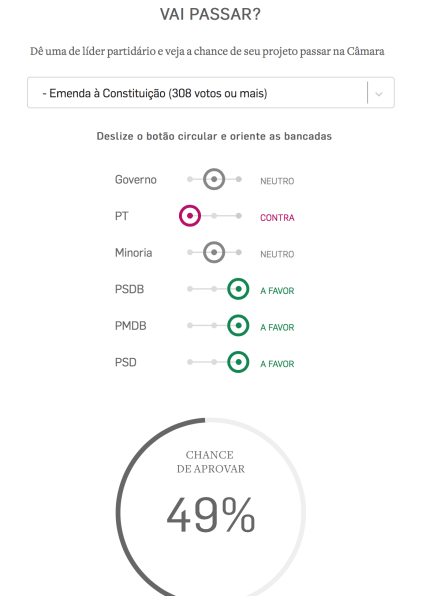
2. O “Vai Passar” do Estadão Dados (mas que não tem a opção de simular com 2/3 dos votos).

Captura de Tela 2015-12-02 às 22.01.57

PS: o que mais gostaria de ver agora seria uma análise com teoria dos jogos explicitando bem todos os jogadores, as jogadas permitidas e respectivos payoffs .

Let the simulations begin!

haven 0.1.0


Dados em SPSS, SAS e Stata? Novo pacote do Hadley chegou ao CRAN para facilitar a sua vida.

RStudio Blog

I’m pleased to announced that the new haven package is now available on CRAN. Haven makes it easy to read data from SAS, SPSS and Stata. Haven has the same goal as the foreign package, but it:

  • Can read binary SAS7BDAT files.
  • Can read Stata13 files.
  • Always returns a data frame.

(Haven also has experimental support for writing SPSS and Stata data. This still has some rough edges but please try it out and report any problems that you find.)

Haven is a binding to the excellent ReadStat C library by Evan Miller. Haven wouldn’t be possible without his hard work – thanks Evan! I’d also like to thank Matt Shotwell who spend a lot of time reverse engineering the SAS binary data format, and Dennis Fisher who tested the SAS code with thousands of SAS files.

Usage

Using haven is easy:

  • Install it, install.packages("haven"),
  • Load it, library(haven)

Ver o post original 416 mais palavras

Fluxo de caixa descontado, O melhor jogo de tabuleiro do planeta, teoria dos jogos e casamentos.


Alguns links interessantes pós-carnaval. Hora de voltar ao ritmo.

– Damodaran fez um post bem bacana sobre fluxo de caixa descontado (FCD), mostrando que não é somente, digamos, um fluxo de caixa descontado. Vale a pena pela etimologia de FCDs mal-feitos e pelo checklist para saber se você está fazendo direito.

– Como fazer o melhor jogo de tabuleiro do planeta? War, Jogo da Vida e Banco Imobiliário estão entre os piores? Dois posts bacanas do 538 que queria ter compartilhado há algum tempo seguem agora aqui e aqui.

– Dollar auction na vida real, por  SMBC:

20141229

VII Congresso da Associação Mineira de Direito e Economia – Lá vamos nós de novo submeter artigos?


Shikida nos lembrando do prazo para submissão do VII Congresso da Associação Mineira de Direito e Economia.

Fale amanhã com Steven Pinker sobre seu novo livro, ao vivo.


No post anterior mencionamos que uma das vantagens de seguir o “clube de leitura” do Zuckerberg era a possibilidade de questionar diretamente os autores. E não é que vai acontecer de novo?

Amanhã, na página A year of books, Steven Pinker vai responder perguntas ao vivo sobre o livro The Better Angels of Our Nature: Why Violence Has Declined.

Shiny 0.11, themes, and dashboard


Nova versão do Shiny com Bootstrap 3.

RStudio Blog

Shiny version 0.11 is available now! Notable changes include:

  • Shiny has migrated from Bootstrap 2 to Bootstrap 3 for its web front end. More on this below.
  • The old jsliders have been replaced with ion.rangeSlider. These sliders look better, are easier for users to interact with, and support updating more fields from the server side.
  • There is a new passwordInput() which can be used to create password fields.
  • New observeEvent() and eventReactive() functions greatly streamline the use of actionButton and other inputs that act more like events than reactive inputs.

For a full set of changes, see the NEWS file. To install, run:

install.packages("shiny")

We’ve also posted an article with notes on upgrading to 0.11.

Bootstrap 3 migration

In all versions of Shiny prior to 0.11, Shiny has used the Bootstrap 2 framework for its web front-end. Shiny generates HTML that is structured to work with Bootstrap, and this makes it…

Ver o post original 355 mais palavras

dplyr 0.4.0


Nova versão do dplyr – que, junto com o data.table – é uma das melhores interfaces para manipulação de dados no R. Nessa nova versão, destaco a possibilidade de trabalhar com listas dentro do summarise, para retornar mais de um valor!

RStudio Blog

I’m very pleased to announce that dplyr 0.4.0 is now available from CRAN. Get the latest version by running:

install.packages("dplyr")

dplyr 0.4.0 includes over 80 minor improvements and bug fixes, which are described in detail in the release notes. Here I wanted to draw your attention to two areas that have particularly improved since dplyr 0.3, two-table verbs and data frame support.

Two table verbs

dplyr now has full support for all two-table verbs provided by SQL:

  • Mutating joins, which add new variables to one table from matching rows in another: inner_join(), left_join(), right_join(), full_join(). (Support for non-equi joins is planned for dplyr 0.5.0.)
  • Filtering joins, which filter observations from one table based on whether or not they match an observation in the other table: semi_join(), anti_join().
  • Set operations, which combine the observations in two data sets as if they were set elements:

Ver o post original 1.114 mais palavras

dplyr 0.3


Excelente update no dplyr! A principal mudança é a facilidade para programar, permitindo que você utilize mais facilmente o dplyr em suas próprias funções/pacotes (sem ter que ficar fazendo malabarismos com eval e substitute).

RStudio Blog

I’m very pleased to announce that dplyr 0.3 is now available from CRAN. Get the latest version by running:

install.packages("dplyr")

There are four major new features:

  • Four new high-level verbs: distinct(), slice(), rename(), and transmute().
  • Three new helper functions between, count(), and data_frame().
  • More flexible join specifications.
  • Support for row-based set operations.

There are two new features of interest to developers. They make it easier to write packages that use dplyr:

  • It’s now much easier to program with dplyr (using standard evaluation).
  • Improved database backends.

I describe each of these in turn below.

New verbs

distinct() returns distinct (unique) rows of a table:

library(nycflights13) # Find all origin-destination pairs flights %>% select(origin, dest) %>% distinct() #> Source: local data frame [224 x 2] #> #> origin dest #> 1 EWR IAH #> 2 LGA IAH #> 3 JFK MIA #> 4 JFK BQN…
Ver o post original 1.285 mais palavras

useR! 2014 – Palestra do John Chambers e entrevista com Hadley Wickham


Eduardo Arino de la Rubia acabou de me informar que, hoje, entrou no ar o site datascience.la, e já com dois vídeos interessantes decorrentes do useR! 2014: uma palestra do John Chambers e uma entrevista com Hadley Wickham.

Após o primeiro dia de tutoriais, o segundo dia da conferência se iniciou com uma apresentação de John Chambers (slides aqui e vídeo abaixo). Para quem não conhece, John Chambers é o criador da linguagem S (pela qual ganhou o prêmio ACM Software System) que se tornou o “pai” do R e atualmente é um dos membros do core team do R. O foco da palestra foi o de ressaltar o papel do R não como uma solução geral que tenta resolver todos os problemas, mas principalmente como uma interface geral que converse com outros instrumentos e ferramentas quando necessário (como, por exemplo, quando a base de dados é muito grande para caber na memória). Para ilustrar iniciativas com esta filosofia, ele citou três frentes em especial:

  • Interface com C++ e C++11, como já havíamos mencionado no post anterior. Os pacotes que têm recebido destaque nesta área são o Rcpp e Rcpp11;
  • LLVM, com o pacote RLLVM do Duncan Temple Lang.
  • Machine Learning em grandes bases de dados e o exemplo foi o H2O e seu pacote homônimo, mas em caixa baixa, para o R.

Confira a apresentação na íntegra abaixo:


Além disso, o Eduardo fez várias entrevistas interessantes no decorrer do encontro e agora começou postar os vídeos. O primeiro deles é com o Hadley Wickham e as perguntas estão excelentes. Vale conferir!